During WWII, Paros Island was first occupied by the Italians in 1941 and then, with the surrender of Italy, by the German Wehrmacht from end of 1943 until October 1944. The main strategic objective to occupy the island was to build an airport there – a dire need for the supply of the German units scattered in the Aegean islands and beyond.
The German unit occupying the island from December 1943 was the Festungs Infanterie Bataillon 1010 ( Fstg.Inf.Btl.1010, St./1.-4. Kp.).
Although, my grandfather Lt. Ludwig Preller wasn’t in this unit (but the V./Festungs Infanterie Bataillon 999) he seems to have been stationed on the island of Paros for some reason or at least to have visited it regularly on duty from September 1943 to December 1943 at least.
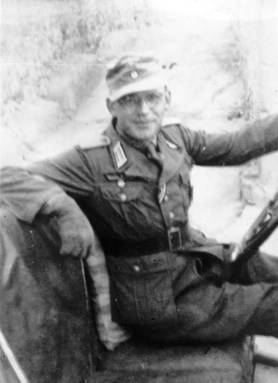
Lt Preller in Paros October 1943
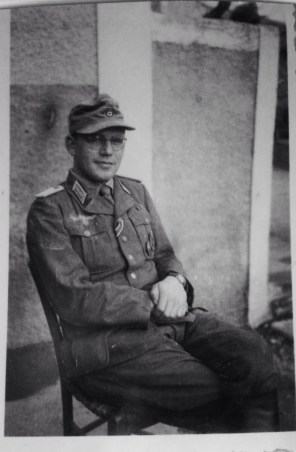
Lt. Ludwig Preller, Paros, Dec. 1943
The Commander of the island was Major Georg Graf von Merenberg.
125 youths to be executed saved
Here is a very interesting story about what happened on the island during the war, the kind of story that makes you believe in humanity again:
http://www.lively-arts.com/humaninterest/2012/03/closed_circle_fs.htm

Photograph of Count von Merenberg, from http://www.lively-arts.com, courtesy of Dr Clotilde von Rintelen, Gräfin von Merenberg. Studio portrait taken 1943.
The commander Major von Merenberg was supposed to apply an order to execute 125 Paros youths in reprisal for the killing of a German soldier – it took some very diplomatic convincing from the Longuvarda monastery monks but he accepted to disobey the order.
Count Georg von Merenberg seems to have been quite a character!… and certainly not a staunch national-socialist, but very much a representative figure of the old Prussian military aristocracy… and with prestigious Russian descent, counting the Russian Zar Alexandre II and the poet Pushkin among his forebears! Although, this wasn’t something to show-off in Nazi Germany…
In fact, his posting on Paros (to oversee the completion of a Luftwaffe airport and base) seems to have been a way to halt his military career – an officer of Prussian background with his trajectory would have had a much higher rank by that stage, had he been more sympathetic with the NS regime.
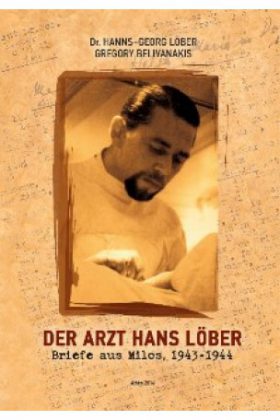
Another positive story: Hans Löber, the “Good medic” of Milos:
An interesting article in Cologne newspaper (2019) about this German military medic’s work healing local people: Hans Loeber Milos 1944
His son published his wartime letters from Milos in this book:
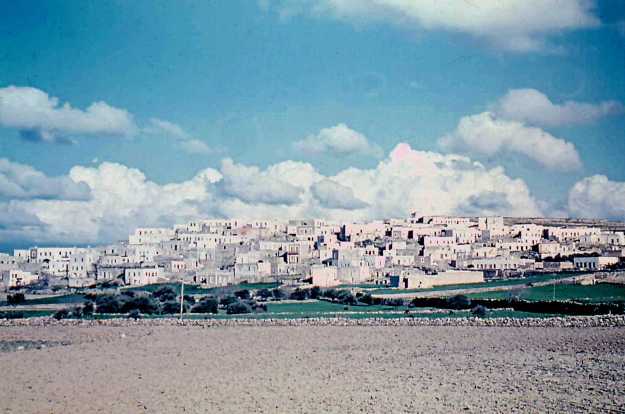
Rare wartime colour photographs of Milos and Paros
I also discovered this absolutely amazing series of photos of Milos and Paros in 1944, including colour shots (!!!) taken by a Grenadier, Albert Petersen, with an obvious talent and expertise for photography:
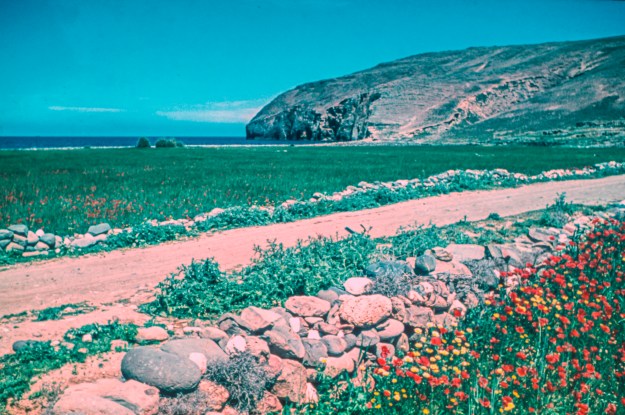
Near Pollomia, Milos 1944. Foto Albert Petersen (with authorisation from L.Petersen)
These were initially on the Photo-platform Panoramio until this was shut down. I was able to get in touch with Albert’s son who very kindly provided me with copies of these.
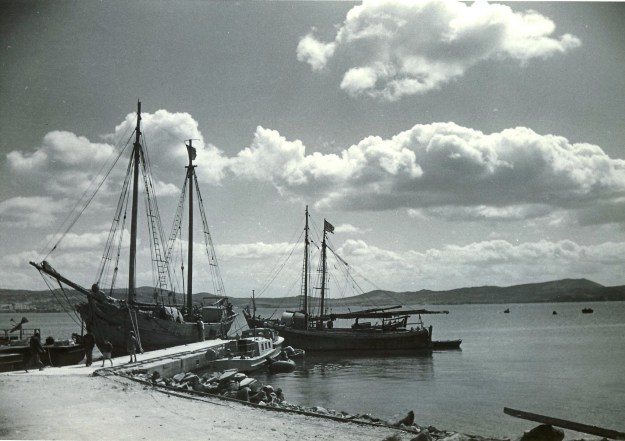
The harbour of Adamas. Photo A. Petersen (courtesy of L.Petersen)
As his son explains in the comments, Albert Petersen wasn’t keen on the war, had very friendly relations with the islanders and ‘discharged himself’ from the Wehrmacht by taking refuge in the Longuvarda monastery (the same one where G. von Merenberg was convinced not to execute 125 young Greeks in reprisal of the killing of German soldiers in a commando action).
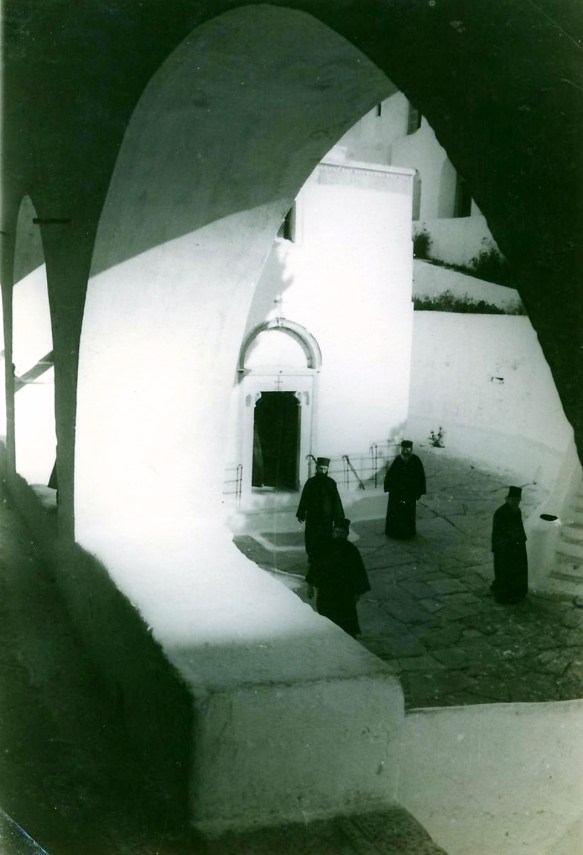
Monastery Longuvarda, Paros, 1944. Photo taken by Albert Petersen, Courtersy of L. Petersen
The initial Panoramia post came with an interesting explanation of the photographers’ trajectory and relationship to locals in comments to one of his pictures of Longuvarda monks:
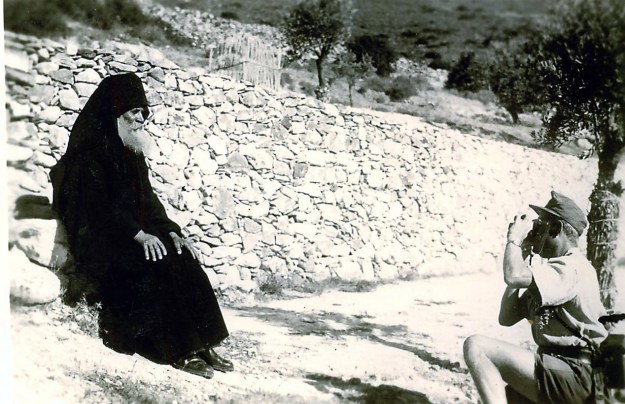
Albert Petersen, taking photograph of a monk (court. L. Petersen)
He also took this beautiful picture of a young lady who he visited again after the war in the 1950s and who was still alive in 2010 and remembered the picture being taken of her:
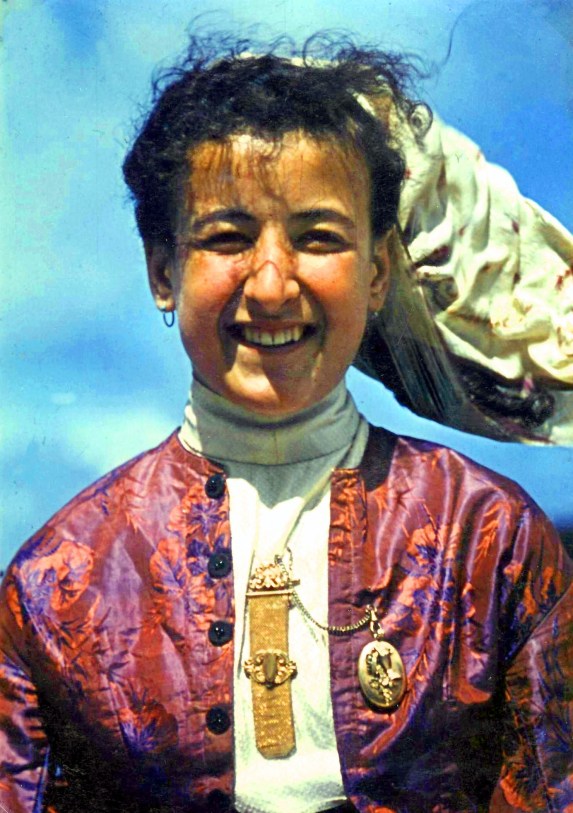
A girl from Milos in traditional dress, 1944. Photo taken by Albert Petersen, courtesy of Lutz Petersen.
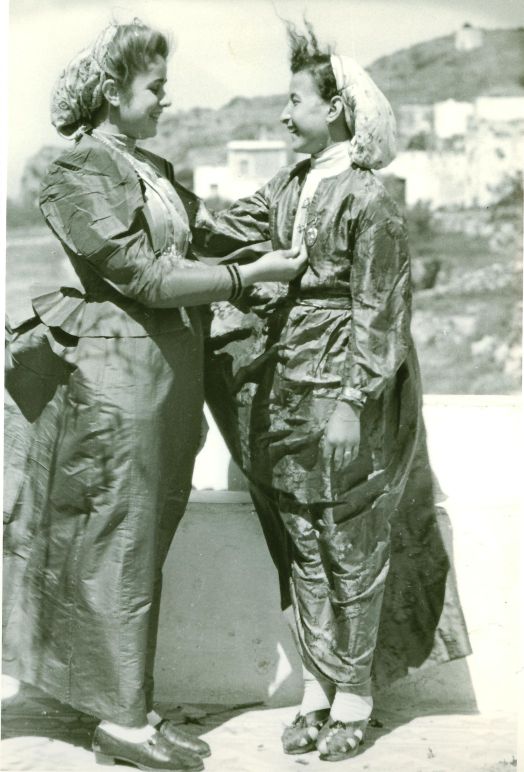
Argiro and Stasia in Limnos (1944? Photo A. Petersen, Courtesy L.Petersen).
 WWII places, objects and family stories
Hello, I would like to see the amazing color fotos you mentioned in your blog, but unfortunately the link is no longer valid. Is there any other option to see the fotos? Thank you, Constantin
Dear Author, I am actually working on a book on Paros under German occupation. I would love to have a look at the photos you mentioned in your blog, but unfortunately the links are no longer valid. Could you please help me? That would be great.
Thanks a lot and best wishes,
Tanja
Dear Tanja,
I believe the links have been working again shortly after you initially wrote, quite some time ago. These photos are not mine they were kindly lent to me as a courtesy for this blog by the grandson of the photographer. I could you put you in contact (we can exchange via private message). How has your book come along? I would be very interested to know about it. Thanks
Hello. I am working on Merenberg’s story and I am very interested in the photos you linked to. Unfortunately, the links don’t work any more. May I ask: Do you still have those photos available and may I ask if you could please help me to have a look at it? That would be great.
All best, Tracine18
Dear Tracine18,
I believe the links have been working again shortly after you initially wrote, quite some time ago. These photos are not mine they were kindly lent to me as a courtesy for this blog by the grandson of the photographer (L. Petersen). How has your research on Merenberg advanced?
I would be very interested to know about it. Thanks