Lemnos/Limnos island

In 1943-44 my grandfather Lt. Ludwig Preller (1918-1945?) was stationed on the island of Lemnos with the V./Festungs Infanterie Bataillon 999, that unit being part of the Festungs Infanterie Regiment 963 (Fstg.Inf.Rgt. 963) under the command of Oberstleutnant Clotz (Rgts.Kdr. Obstlt. Clotz), later Oberst Clotz when the regiment was upgraded for Festungs Infanterie Brigade 963 (also known as ‘Brigade Clotz’).


Leutnant Ludwig Preller in Greece, 30 April 1944.
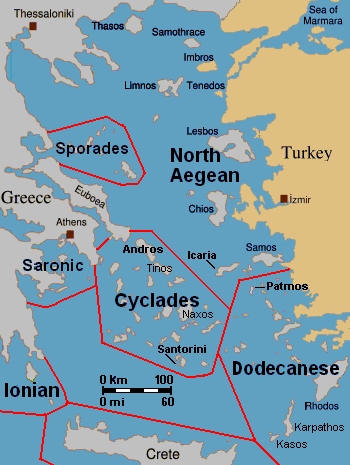
Situated in the Northern Aegean, the island (see map) played an important role during World War I for the Allies’ Dardanelles campaign, as the bay of Moudros served as a base for allied ships in the battle of Galipoli. This place if of particular national commemorative significance to Australian and New Zealand families of the ANZAC soldiers and nurses who participated in this campaign.

During WWII, the island was occupied by the Germans on 25 April 1941, in the wake of the Wehrmacht’s invasion of Greece, by the Infanterie Regiment 382/164 Inf.Division under the command of Oberst Wilhelm-Helmuth Beukemann (see corresponding thread in the ‘Forum der Wehrmacht‘). The same bay of Moudros served as a base for German ships controlling the northern Aegean sea.

I found this rare photograph (on the forum MapleLeafUp) of the truck used by the Hafenkommandant of Kastron (today Myrina) on Lemnos, which is a captured British vehicle.

 Old army bunker on a hilltop in Lemnos, with telecommunications mast. Source: https://www.alamy.com/stock-photo-a-telecommunications-mast-on-a-hill-top-on-lemnos-greece-with-an-old-51228730.html
The end of the Afrika Korps and the Greek islands instead
In 1943, with the defeat of the Rommel’s Afrika Korps in Tunisia, the German High Command decided to reinforce the defenses of the Balkan coast-line including Northern Greece and the Peloponese islands. Rommel himself visited Saloniki in July 1943 to this purpose (see German propaganda film footage here). This is how many troops initially meant to be sent to Tunisia to bolster the Afrika Korps were then dispatched to Greece, including reinforcements for the Leichte Afrika Division. This explains the Afrika Korps “Troppen-Uniform” and equipment used by the units in the area.
This is also the period when the so-called “punishment-bataillons” were sent from Heuberg to Saloniki and the Peloponese islands, including the 963 Afrika Schutzen Regiment sent to Lemnos.The “999” punishment units in the Northern Aegean
Anti-nazi political prisoners as Wehrmacht soldiers!
As is well documented, the “999” units in Greece were composed of former-prisoners, both so-called common criminals (under the nazi definition for this, which included for instance homosexuals!) and political (roughly 50/50%), as also evidenced through information from my grandfather on the 963 Afrika Schutzen Regiment (see here). Among the ‘politicals’ quite a few (generally with a communist party, KPD, or Social Democrat, SPD, background) ended up going over to the Greek resistance movement ELAS.
Such was the case for instance of reknowned socialist jurist and political scientist Wolfgang Abendroth (1906-1985), an important contributor to the constitutional foundation of postwar West Germany.

As a lecturer he oversaw the habilitation in political science of major German philosopher, sociologist, and political theorist Jürgen Habermas.

His account of his period on Lemnos and how he went over to the Greek resistance movement in 1944 gives some interesting insights into the military-political conditions on the island.
From September 1944, the German forces progressively withdrew from Lemnos to the mainland via Thessaloniki. This was the case of my grandfather’s unit, the V./Festungs Infanterie Bataillon 999 which was transported to Thessaloniki beginning of September.
The island was liberated by the British forces, or rather by the Greek Sacred Squadron/Regiment (or initially ‘Greek Sacred Band’) under the command of the British Raiding Forces on 16 and 17 of October 1944.
Further Anti-Nazi resistance fighters in Lemnos
Kurt Bennewitz (shot by the SS in 1945 at Loiblpass)
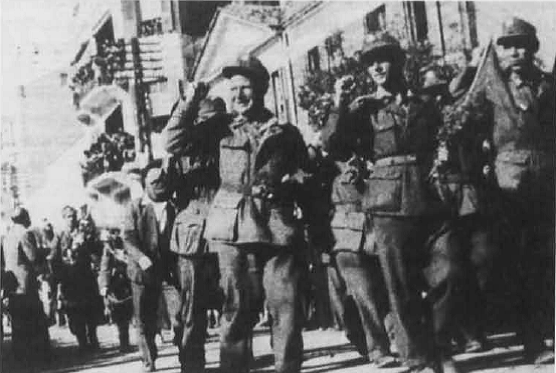
Bernhard Sühlbrandt : Communist, went over to ELAS Greek resistance, seen in 1st November 1944 liberation Parade in Thessaloniki, see photo below – copy from Hans-Peter Klausch, 1986, Die 999er. Sühlbrandt is the last one on the right of the picture.
(Under work…)
Adendum (31/08/2023): War Photographer Erich Rinka on Lemnos/Limnos
I recently discovered a new series of photographs taken by the war photographer Erich Rinka on Lemnos in 1943/44.
They can be found here on the German Digital Library:
But it never says which unit it is, less the names of the officers and rarely the places… hopefully someone knowledgeable seeing these could help identifying people and places!
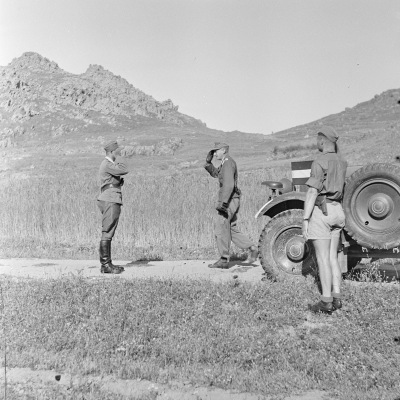
Rinka, Erich: Griechenland. Insel Limnos. “Soldaten der Wehrmacht im Einsatz”, 1943/1944 Source: Deutsche Digitale Bibliothek
I am still trying to identify this officer who appears often in Erich Rinka’s photo series of Lemnos:
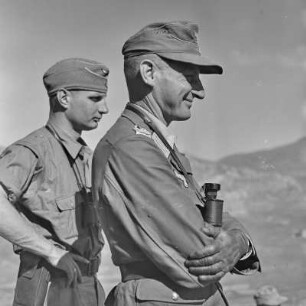
Any held with the identification most welcome!
Further information on the Island of Lemnos:
Lemnos during WWI:
http://lemnosgallipolicc.blogspot.mx/2014_09_01_archive.html
On Wolfgang Abendroth:
http://www.barth-engelbart.de/?p=29092
https://socialhistory.org/en/collections/wolfgang-abendroth?language=nl
https://de.wikipedia.org/wiki/Wolfgang_Abendroth
http://www.spiegel.de/spiegel/print/d-46034494.html
http://www.spiegel.de/spiegel/print/d-13516517.html
http://www.gdw-berlin.de/en/recess/biographies/index_of_persons/biographie/view-bio/abendroth/
On British forces liberating the island:
Australian newspaper clip from 23 October 1944: http://trove.nla.gov.au/newspaper/article/11366819
 WWII places, objects and family stories