Note: All photos have private copyright. Please ask permission before re-using or at least mention the source as https://ww2placesobjectsfamily.wordpress.com Thank you!
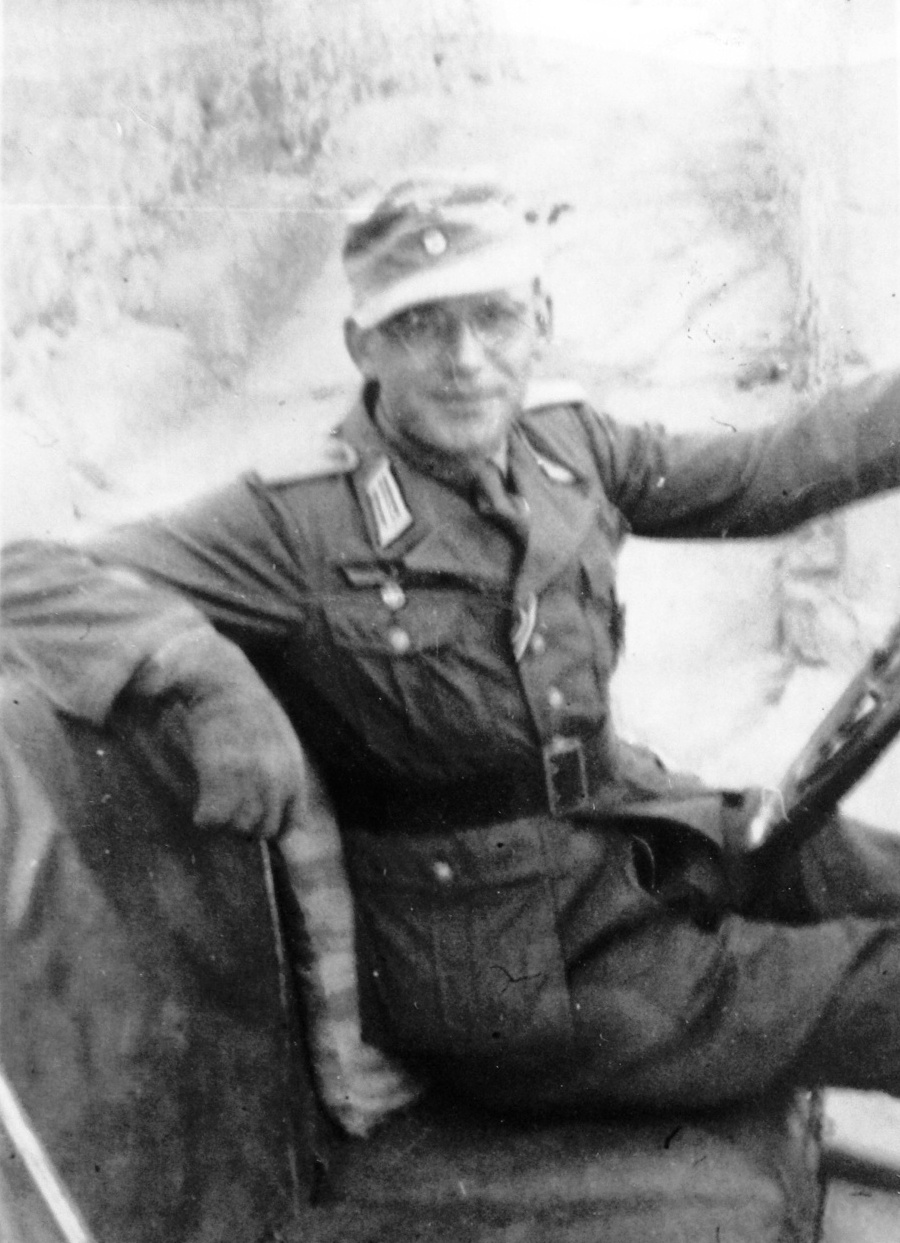
My great-uncle Hans Herrmann (13 March 1915 – 3 November 2003), then still a
first lieutenant (Oberleutnant), was in Greece with the “Flak-Lehr-Regiment” or “anti-aircraft training regiment”. He told me a few things about it, but I would like to learn more about the unit and its deployment in Greece, and I hope that others online on wordpress or other fora might also find this interesting.
Hans Hermann was battery commander in the II. Abteilung of the Flak-Lehr-Regiment from autumn 1940 to spring 1942. With this unit, after home-front defensive positions near Regensburg (Weissenburg) and Hamburg, which involved training new recruits, and a short stint in France in June 1940, he was first deployed to Romania (Ploeszti to defend the oil refineries there), then to Greece (April-May 1941). The initial plan had actually been to be sent to Afrika, and the units were equiped for the “tropics”… but they were diverted for Hitler’s move on Greece. Hans Herrmann was meant to land in Crete in May 1941 in connection with Operation Mercury (Merkur). However, I know from his stories that he was lucky because the small fishing steamboat on which he and his anti-aircraft guns were being transported to Crete had to turn back due to a mechanical problem… that probably saved his life, because most of the other boats were sunk!
He still received his Crete sleeve insignia afterwards, which I now have!
Below: a photo of Oberleutnant Herrmann (centre-left) with fellow officers of the II./Flak-Lehr-Regiment at their camp by the beach near Saloniki. May 1941. Centre-right, Major Wolfgram? First left (right-side of H. Herrmann) seems to be Leutnant Dahms.

According to the application letter Hans Herrmann wrote in 1955 to join the Bundeswehr, the commanders of the II. Abt./Flak-Lehr-Regiment during that period (autumn 1940 to spring 1942) were first Major Wolfgram and then Major Lyneker. However, I do not have the exact date of the change of command. Apart from Major Wolfgram (apparently the tactical symbol of the unit, a wolf, was chosen after his surname!), he also often mentioned Lieutenant Dahms. They also appear in photos from that time. The famous greek-german military historian, Byron Tesapsides (RIP), had informed me privately that according to his archival research Major Wolfgram and Lieutenant Dahms both died during the crossing to Crete with the ship squadron. This corelates with what my great-uncle had told me during interviews I carried out with him in the 1990s.
Losses of the II. Abteilung/Flak Lehr-Reg. (2nd battalion/Anti-Aircraft Training Regiment), among others:
– Commander, Kdr. (commander) Major Erich Wolfgram, (deceased 21 May 1941), – Adjutant, Lt. Hermann Dahms, (deceased 21 May 1941), – Battalion medic (Btl.Arzt, O.Arzt), Dr. Johannes Thies, (deceased 21 May 1941). – Oblt. Götte, commander of the 10th battery (same date?)
Dr. Thies was burried at the German military cimetery of Maleme (Bloc 2 tumb 255). The bodies of Major Wolgram and Lt. Dahms could not be retrieved (lost at sea, they are officially still reported as “missing”).
Apparently Hans Hermann commanded the 10th Batterie, or maybe first he commanded one of its platoons/Züge until Oblt. Götte’s death and then took over the Batterie-command as Byron Tesapsides based on the field-postcode “Feldpostnummer” 30638). Perhaps others reading this can help with some of this (more details on Oblt. Götte?) and also with the various locations of the II. Abteilung of the Flak Lehr-Reg. My great-uncle mostly mentioned Saloniki, Athens and Chalkis…
I attach here and in the link below a scanned copy of a document (in German) about the operation ‘MERKUR’/Invasion of Crete, which my great-uncle Hans Hermann
gave me in the 1990s. Unfortunately, it is not dated (or signed by name), and I am not sure whether the “Deutsches Luftwaffenübungsplatz-kommando Suda Bucht” or “German Air Force Training Area Command Suda Bay” already existed during the war
or whether it only refers to the later NATO training base established there with participation of the post-war Luftwaffe of the Federal Republic of Germany.
I think I remember my great-uncle mentioning he received this document after the war,
either in his capacity as a Bundeswehr officer or through contacts in the circle of his former comrades of the II./Leichte Abteilung of the Flak-Lehr-Regiment.
The events concerning the sea transport and the II. Schiff-Staffel are mentioned on pages 25-29 (with a photo by Hans Hermman attached).
The link to the document:
https://ww2placesobjectsfamily.wordpress.com/wp-content/upl…merkur-1941.pdf
I would very much like to hear from specialists or anyone with an interest on the Crete-invasion and have opinions on this document and also anything you might know about the ‘German Air Force Training Area Command Suda Bay’!
Massive ship explosion in the port of Piraeus, Athens Mai 1941
In 1988, when he was 73, Hans had told me of his witnessing of the huge explosion of a ship in the harbour of Athens, believed by him to be due to sabotage actions by resistance or a special comando. Years later he unearthed his old war-time photographs and handed them over to me. To my surprise, with a stack of photos and corresponding negative rolls of May and June 1941, there was this photo corresponding to that very event:

Credits: Photo by Hans Herrmann – copyright, private collection N. Preller-Ellison
Hans’ war-time handwritten comment on the back of the photograph reads “Explosion of an ammunition supply ship, by partisans? Athens 1941.”
Trying to find out more discussing this with specialists, late Aeagean WWII historian Byron Tesaspsides (see Forum der Wehrmacht thread from 20 June 2017) had clarified to that there was no partisan activity yet mid-1941, and that this was probably the Bulgarian cargo “Maria Luise” which exploded after a fire on board set off the explosives, ammunition and petrol/gasoline stocked on board (what a mix to be transporting!). Three other boats were damage and sunk as a consequence of that explosion).




 WWII places, objects and family stories